Kawasaki Motorcycle
Sunday, April 22, 2012
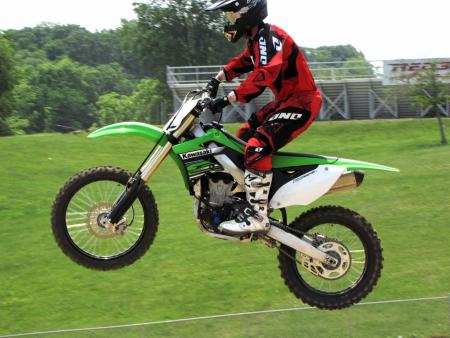
Kawasaki KX450F Review - First Impressions
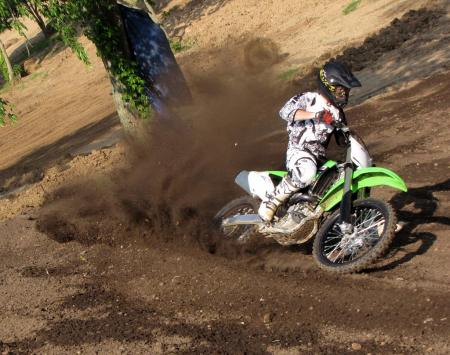
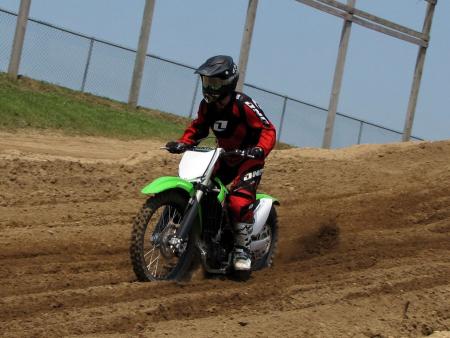
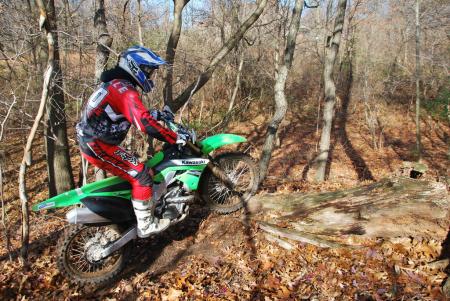
The Kawasaki KX450F is becoming the jack-of-all-trades in the dirt-bike world. KX450Fs have been on Pro podiums at Motocross, Supercross, WORCS, GNCC, Endurocross and even Flat Track races. The KX450F's success has always revolved around two major traits: huge power and its ability to perform fairly well at just about everything.
Though it won races, the KX’s large rider ergonomics, excessive weight, abrupt (some would say rude) low-end power delivery and less than sharp cornering manners have traditionally held the KX450F from winning popularity contests. After we rode the 2011 version on everything from frozen lakes to motocross to cross-country to flat track, we pretty much had the bike figured out. When we learned about the changes Kawasaki made to the KX450F for 2012, we couldn’t wait to try it at its press launch at the famous Red Bud track in Buchanan, MI.
Everything you’ve always wanted in a KX450F. And less.
Kawasaki is proud of the improvements it made to the 2012 KX450F. We’ll run through a quick recap,
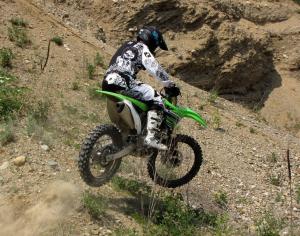
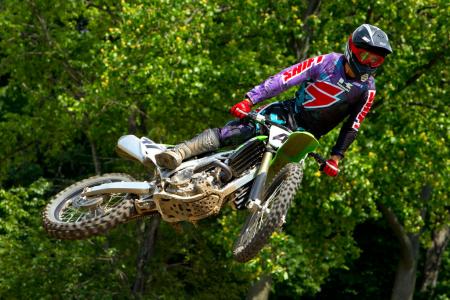
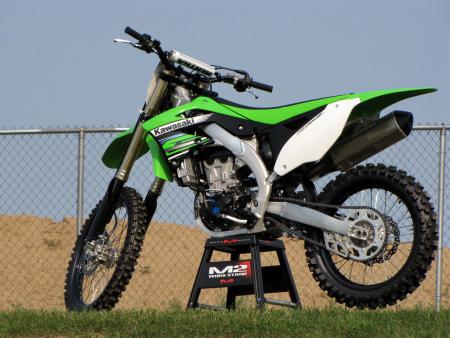
KX450Fs have won everywhere, from the Supercross tracks to the desert. We expect that streak to continue in 2012.
Kawasaki addressed the too big complaints in a variety of ways. First, there's a new, slimmer frame, but more importantly the handlebars can be adjusted to four different settings thanks to new triple clamps, while footpegs can be raised or lowered to fit your personal preference. If the KX450F still feels a little big, there's an optional suspension linkage that drops seat height 6mm. The end result is the most ergonomically adjustable motocross bike in recent memory.
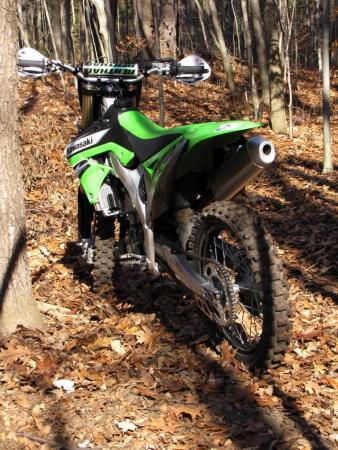
Kawasaki also worked to improve reliability by including a thicker first gear, a revised crankshaft designed to improve low-end throttle response and engine balance, and thinner piston rings to improve throttle response. They cut small bits of weight all over the bike, going so far as to install a lighter fuel pump. A revised fuel injection system makes EFI tuning easier than ever. A new exhaust system was designed to cut weight, boost performance and still meet AMA sound regulations. Something totally new is the Kawasaki Launch Control System. It is designed to improve traction and rideability off the starting line before it kicks back into ‘normal’ mode when the rider selects third gear.
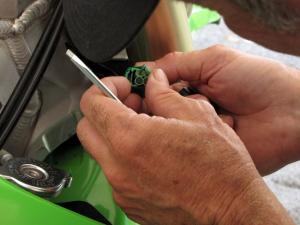
Plug and play. Swapping between the three basic fuel injection maps takes only a few seconds.
Red Bud is an amazing motocross facility, with nicely groomed grounds and a world-class motocross track. Obviously you can’t do a ‘real world’ motorcycle test on one perfectly groomed national-level motocross track with factory technicians looking over your shoulders. We tried to find varied riding conditions in addition to the motocross track, but this is more of a ‘first impression’ report than a proper motorcycle test. Our first impression, after having spent so much time on 2011 and 2010 KX450Fs, was how the 2012 model felt much smaller and lighter than its predecessors.
One thing that helped cornering and overall rideability on the 2011 KX450F was to recalibrate the milder fuel injection mapping at the bottom end of the powerband. Fuel-injection tuning on previous KX450Fs was complicated, requiring special programs and adaptors. On the 2012 model swapping between three basic EFI maps takes 10 seconds with no special tools. Kawasaki has three color-coded EFI plugs, soft terrain, intermediate-normal, and hard terrain that simply click into the wiring harness. The hard terrain map is designed for low-traction conditions, so it’s actually the ‘softest’ powerband of the three. At first we were embarrassed to admit we preferred the softer-hit of the ‘hard pack/no traction’ map, but found out later that most of the other magazine editors liked the gentler map better too.
Ergonomic upgrades help make the 2012 KX450F feel noticeably lighter than its predecessors.
Even brand new, with zero-time on the clock, the 2012 KX450F shifted nicely under power and the clutch worked well. We did notice a sizable gap between second and third gear ratios that was a little too big. Adding a tooth or two to the rear sprocket would be an improvement. The light and progressive clutch feel really helps the manners of the KX450F, but how long that clutch will last remains to be seen. Kawasaki has upgraded the 2012 to use slightly stiffer clutch springs to cure the well-publicized premature wear problem they had with older models. In the two days we rode the 2012 the clutch never faded or needed excessive adjustment. First gear is even low enough for off-road use, especially considering there is so much torque on tap.
Light and precise clutch action make the KX450F surprisingly easy to ride in low-traction situations.
It was a blistering 97F on day-two. When we were going slow and pretending to be Endurocrossers, we cooled off the KX450F by splashing through some water, but we didn’t need to. The radiators gurgled a little in slow running but never boiled out their coolant. That’s another improvement over the 2010 and 2011 models. Sometimes when the engine got really hot it would flame out at low rpm and take several kicks to restart. That’s something we never had a problem with last year and could likely be cured with careful EFI tuning. Aside from the three basic ‘plug and play’ maps the new Kawasaki fuel injection system is infinitely variable through a normal Windows PC.
Despite some major changes to the chassis, vague cornering remains as one of the KX450F's traits. This is a big, powerful motorcycle that likes to be steered with the throttle. When ridden aggressively it will power around turns quickly, but it won’t rule the inside line. The 2012 KX450F will turn sharply, but you have to work at it and the bike does wander more than we’d like.
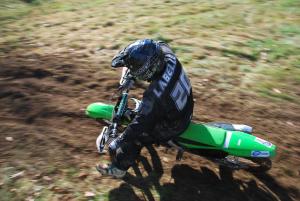
The KX-F likes slam dancing, not ballet. It likes to turn with a fist full of throttle and the rear wheel spinning.
We tried to improve cornering by adjusting fork height, fork rebound and compression settings, rear suspension sag and high-speed compression and handlebar positioning to find the ideal balance between traction, stability and turning ability. Cornering improved but was never great. That being said, the big Kawasaki is exceptionally stable at speed. The rear brake on the KX450F is excellent but the front remains average. We bled the front brake and tried different lever adjustments but never got rid of the touchy ‘on or off’ feel. Different pads or a different rotor might help. We’d like to try a different front tire as well, which could potentially improve both cornering and braking performance.
The suspension soaks up hard landings without a whimper, even when pushed to the stops. Small bump performance is another matter, as the bike hops around too much and transmits too much track hack to the rider.
The 2012 KX450Fs suspension did beat us up over smaller square-edged impacts on the track. It was difficult to get the shock preload backed off enough to get 95-100mm of sag with a 160-pound rider. Heavier riders didn’t complain as much, but it’d be nice if Kawasaki equipped the 450 with the SFF preload-adjustable forks it uses on the 250F. Kawasaki changed the shock linkage this year to improve rear wheel traction. Careful chassis set-up was essential, and when we backed off the compression to absorb chop the bike became more difficult to jump. Bottoming resistance was always excellent, and even when the suspension bottomed out the impact was never overly harsh.
Keeping in mind that we are probably lighter than the average 450 rider, here were our favorite chassis settings at Red Bud:
Our KX450F Settings at Red Bud
Fork Height +7mm above the top triple clamp
Ford Compression 14 out (stock 10)
Fork Rebound 10 out (stock)
Shock Race Sag 95mm
Shock LS Compression 12 out (stock 10)
Shock HS Compression 1/4 turn in (Stock 1.5 turns)
2012 Kawasaki Kawasaki Launch Control: Better starts through the magic of electronics.
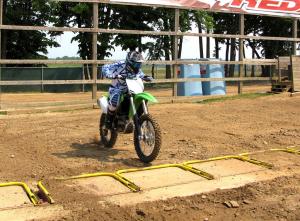
Kawasaki techs told us to forget worrying about using perfect starting techniques, adding that the Launch Control System rewards Novice riders more than it does Pros. Here’s how it works. Ride up to the starting gate and push the Launch Control button until it flashes. Select second gear, pin it and dump the clutch when the gate drops. The ignition timing is retarded slightly by the Launch Control System until the rider up shifts into third gear, improving traction.
Click here to see a second-gear start with the Launch Control System turned OFF.
Click here to see the same start in second gear with the Launch Control turned ON.
The Kawasaki Launch Control system doesn’t work for third gear starts, which is unfortunate since our testers found it easier and smoother to leave the gate in third. The Kawasaki has ample torque and horsepower for strong third gear starts, as you can see here.
On the second day at Red Bud we headed away from the track to get a rough idea of how the KX450F would work in non-motocross conditions.
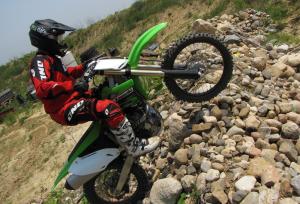
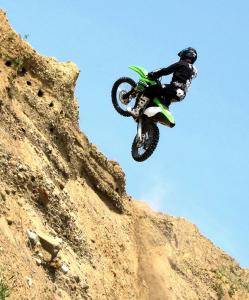
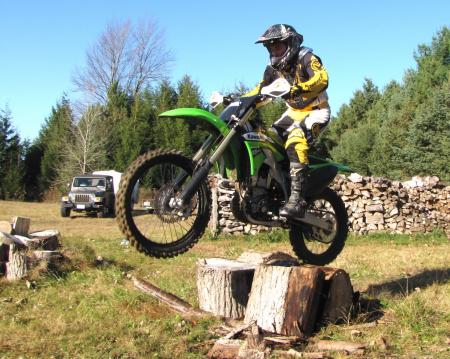
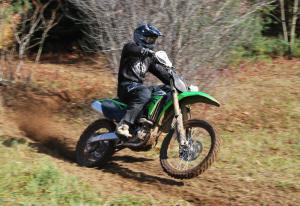
The KX-F is actually a fun play bike. It begs you to find impossible hills and to turn every lump of dirt into a jump. With a low first gear, smooth clutch and long-feeling wheelbase the KX450F excels at clawing up gnarly hills, but the harsh suspension deflects too much off sharp square edged hits and makes it tough to hold your line. Last year’s bike soaked up trail junk acceptably at race pace, but the 2012 feels harsher. That could be because of the new for 2012 seat foam or the new suspension linkage or the new frame. In any case we aren’t sure why just yet. Fuel range will be less in 2012 than it was in 2011, since the narrower frame and flatter seating position reduced the gas tank capacity from 1.9 to 1.6 gallons. The new exhaust was pleasantly quiet at first but became too loud by the six-hour mark.
So what do we think? We need more time to ride and learn to live with the KX450F before we can give a full answer. The 2012 KX450F is a motorcycle that can win races. We like the 2012 better than the 2011 model because it feels more compact and aggressive. The classic KX450F traits are pretty much the same, but overall performance level and reliability has gone up. Hopefully we’ll get a chance to ride and evaluate a 2012 KX450F in the real world.
Thanks to Kawasaki USA for the invite to the 2012 KX450F press launch, Red Bud for providing the amazing test facility, and Jim Carver for helping provide test input.
We’re looking forward to spending more time riding and spinning wrenches on the 2012 KX450F. This bike has huge winning potential in the hands of a competent tuner.
Kawasaki Street Models Updates
It’s a year of significant updates for four existing Kawasaki models. The headlining news is the ZX-14R mega-sportbike, using a bigger, more powerful engine and receiving hundreds of other revisions to finally leave Suzuki’s Hayabusa in the rearview mirror. So much was changed it deserved its own article you should read here.
But Kawasaki’s R&D department has been busy upgrading other streetbikes in its lineup, including a significantly updated Ninja 650, ABS added as an option on the Ninja 1000, and the Vulcan 1700 Voyager is equipped with an innovative heat-management system.
2012 Ninja 650
Like the new ZX-14R announced today, the 2012 Ninja 650 celebrates six years as part of Kawasaki’s street lineup. And also like the big Ninja, the 650 gets significantly updated for 2012.
The 2012 Ninja 650 receives a new frame and swingarm, as well as exhaust revisions for improved mid-range, and styling updates influenced by the all-new ZX-14R.
The sporty but fuel-conscious 649cc parallel-Twin powering this middleweight Ninja streetbike sees updates in the exhaust system, including a new header-section connector pipe and a three-chamber muffler design. This new exhaust is a key contributor to improved gains in mid-range power according to Kawi.
Holding the engine is an all-new twin-pipe perimeter frame – nearly 2 inches (50mm) narrower in the knee/footpeg area – and is joined by a cool, new twin-pipe swingarm.
New twin-tube style swingarm is prominently displayed; it creates a less-cluttered look and better matches the lines of the new frame. A new footpeg hanger is also well-integrated visually.
All-new instrument panel includes an analog tachometer, which should prove much easer to read than the digital tach on the previous 650’s all-LCD gauge cluster. The Ninja 650 also gets a new, 3-position windscreen.
Both are said to provide increased rigidity over the previous 650’s frame. A new backbone-type subframe also offers a 10% increase in maximum carrying capacity. Rake and wheelbase remains the same as last year, while trail sees a nominal increase from 4.2 to 4.3 inches.
Revised suspension settings, including a 0.2-inch increase in travel front and rear (4.9” front, 5.1” rear), are apparently aimed at improved rider comfort. Although Kawasaki doesn’t specify as to the suspension updates other than the moderate increase in travel, we speculate minor internal changes for improved damping performance.
Effort at the clutch was reduced, new brake pad materials promise a slight increase in braking power, and Dunlop’s new Roadsmart II tires are now standard.
Rider ergos see comfort improvements in the form of a 20mm wider handlebar and a two-piece seat assembly with foam that’s wider and thicker. Seat foam thickness likely accounts for the 0.6-inch increase from last year’s seat height that’s now at 31.7 inches. Both the handlebar and saddle are rubber-mounted, along with the footpegs, to help mitigate vibration from the inherently buzzy vertical-Twin engine design.
A new instrument panel features an analog tachometer situated above an LCD info-panel showing speed, trip meters, fuel consumption, remaining range, etc., and the ignition is now located at the fuel tank assembly in order to give a clear view of the gauge cluster.
Bodywork was updated for better aerodynamics and improved engine-heat dissipation, while styling was influenced by the ZX-14R’s appearance. The manually adjusted, three-position windscreen we like so much on the 2011 Ninja 1000 was apparently a big hit elsewhere, as the 2012 Ninja 650 now also sports a three-position shield. However, unlike the Ninja 1000’s simple hand-operated, tool-less shield adjustment, the Ninja 650’s shield requires the use of tools to alter positions.
Fuel capacity of 4.2 gallons is up 0.1-gallon from last year, and battery size was decreased. Also up is curb weight, going from just under 450 pounds in 2011 to a little less than 461 pounds on the ’12 model.
Various revisions to the Ninja 650 should make Kawasaki’s likeable middleweight streetbike all the more appealing in 2012.
The 2012 Ninja 650 comes in Metallic Spark Black, Candy Lime Green or Passion Red, and has an MSRP of $7499.
2012 Ninja 1000 ABS
In our 2011 Gentlemen Sportbike Shootout we lauded the brawny Ninja 1000 for its appealing combination of rider comfort, excellent overall chassis performance and powerful but smooth 1043cc inline-Four.
It appears nothing will alter those admirable qualities on the 2012 Ninja 1000. What will change is the option to select a Ninja 1000 with increased rider safety features, as ABS is now available on the Ninja 1K. And, thankfully, the addition of ABS adds only 6.7 pounds to the non-ABS model’s 502.7-pound curb weight, which is unchanged from last year.
The brawny Ninja 1000 receives optional ABS for 2012.
Base model Ninja 1000 MSRP is listed at $11,199, up a mere $200 from last year’s bike, while the ABS-equipped 2012 model retails for $11,899. Colors available for the 2012 Ninja 1000 are Metallic Spark Black/Metallic Flat Micron Gray or Candy Lime Green/Ebony.
2012 Vulcan 1700 Voyager
Despite the now years-long flabby world economy that’s clearly affected the whole of motorcycling, the cruiser market – a staple of the U.S. bike scene – has remained a leading segment. Furthermore, the bagger and touring sub-segments of the cruiser market are burgeoning – take, for example, the success of Victory’s Cross Country and Cross Roads models. But newcomers aside, Kawasaki has been a player in the V-Twin powered big rig touring game for more than just a blink of an eye.
Headlining news for Kawasaki’s big touring rig is improved airflow management said to reduce the amount of engine heat both rider and passenger feel.
In 2009 Kawasaki resurrected the Voyager name, using the new Vulcan 1700 platform to create a V-Twin touring bike to compete with H-D’s popular Electra Glide. At the time, Kawi boasted the big Vulcan as the first V-Twin-powered full-dress tourer from Japan. What Kawi has recently decided to address with its muscle-car-inspired touring rig is the undesirable, thrill-killing amount of heat generated from the rear cylinder of a big-bore V-Twin. The following year, Kawi added heat deflectors that proved to be only marginally successful, which you can read about in our 2010 Voyager Review
Despite the fact that its large-displacement Vulcan is liquid-cooled, the nature of full-dress models with leg shields is problematic engine heat since the rear cylinder and exhaust pipe are almost directly under the rider. In a proactive move Kawasaki is now providing, as standard equipment, an air management system to help increase rider comfort at a stop.
New for the 2012 Voyager is Kawasaki Air Management System.
The primary part of the Kawasaki Air Management System (KAMS) routes radiator heat to the ground, below the engine, while the secondary part of the system draws heat away from the rear cylinder and exhaust pipe and directs it to the ground on the left side of the motorcycle. Team Green says this system is particularly effective in warm weather while stopped in traffic or for extended periods of low-speed operation.
The Vulcan 1700 Voyager received a nominal $400 increase in MSRP for 2012.
Colors for the 2012 Vulcan 1700 Voyager are Metallic Graystone / Metallic Spark Black or Pearl Alpine White / Pearl Luster Beige. The non-ABS model retails for $17,899 – a $400 increase from 2011. The ABS model has an MSRP of $18,999. A 36-month warranty is standard.
Kawasaki Vulcan 1700 Vaquero Review
According to Croft Long, cruiser and personal watercraft product manager at Kawasaki Motors Corp., U.S.A. (KMC), Team Green’s new Vulcan 1700 Vaquero is something of a transitional model for riders of smaller displacement or more basic cruisers.
The company discovered that riders looking to move up from smaller cruisers to a larger model aren’t necessarily interested in or ready for full touring boats, like the Vulcan Voyager, Harley-Davidson’s Electra Glide models or H-D’s Road Glide Ultra.
Of course, the Vaquero is also crafted as a bike with an appeal all its own, drawing in riders that don’t always have a cruiser background – like ZX-14 owners. Long says these riders are part of the Vaquero’s demographic, as they look either to switch two-wheeled genres or further expand the type of mounts they ride.
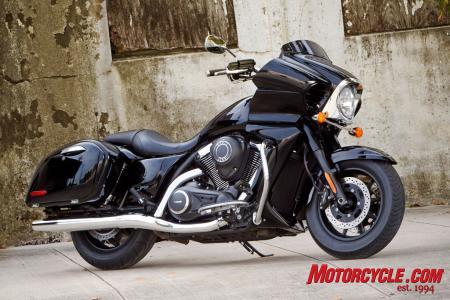
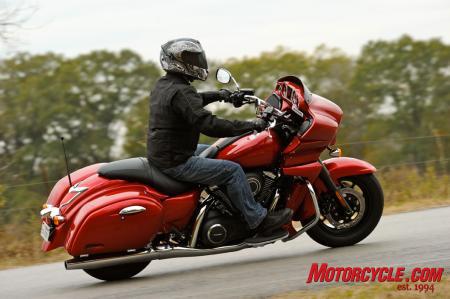
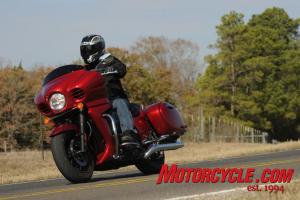
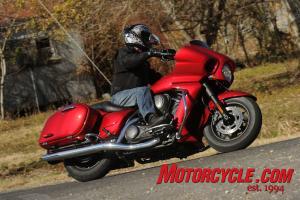
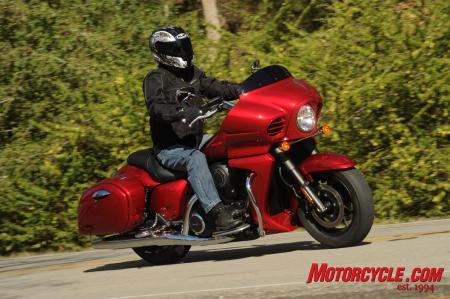
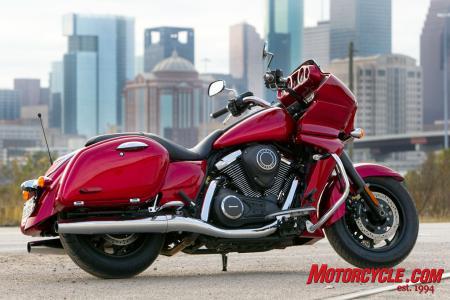
2011 Kawasaki Vulcan 1700 Vaquero. This latest bike to join the big-bore Vulcan lineup is Kawasaki’s step into what is known as the bagger cruiser segment. Other bikes in this category include Harley-Davidson’s Street Glide, Road Glide Custom and Victory’s Cross Country, to name just a couple.
And, naturally, with this latest Vulcan, Kawasaki hopes to woo riders from other cruiser brands as well.
During the Vaquero’s recent press launch in Montgomery, Texas, an hour or so north of Houston, Kawasaki staff didn’t specifically say the intent was to get in on the growing bagger sub-segment with the Vaquero, but more often referred to it as the next-step bike mentioned above.
Regardless of how much candor Team Green was willing or able to speak with on this matter of entering the realm of Harley’s Road Glide Custom and Street Glide models, Victory’s Cross Country and Star’s Stratoliner Deluxe, the fact is, with the Vaquero, Kawasaki has beat Honda and Suzuki to the lucrative bagger market.
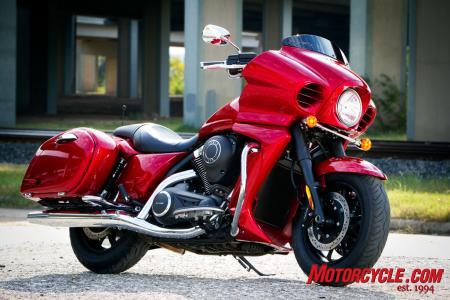
The Vaquero’s styling is undeniably influenced by Harley’s Road Glide Custom. However, Kawi adds various touches to the Vaquero’s looks, like the Candy Fire Red bike’s color-matched headlight trim and color-matched inner fairing, in an effort to set the Vaquero apart from its competition.
To give you a sense of how important this part of the cruiser world is, Harley-Davidson says (without revealing any sales figures) the Street Glide is its top-selling model. Perhaps Honda and Suzuki don’t currently have any designs on the bagger game, but it would seem a wise move to join the party.
Another steel horse in the Vulcan stable
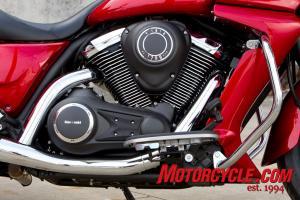
At its core the Vaquero is a Vulcan 1700. The latest V bike in Kawi’s big cruiser lineup shares its 1700cc (103.7 c.i.) liquid-cooled, SOHC, four-valve-per-cylinder, 52-degree V-Twin engine carried in a steel-tube cradle-type frame basic platform with its Vulcan Classic, Vulcan Nomad and Vulcan Voyager/ABS stablemates.
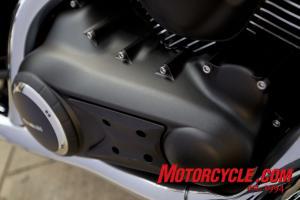
Changes to the 1700cc Twin unique to the Vaquero for 2011 include a new second piston ring for “improved durability,” and in the interest of weight reduction the lower primary chain guide was eliminated. Also specific to the Vaquero is a new first-gear ratio said to reduce shifting noise when clicking from neutral to first. Revised cogs for third and fourth gear also work to smooth out shifting action while reducing clatter from the gearbox.
A lot of external components that would usually have chrome surfaces get the black-out treatment on the Vaquero. Although the Vaquero’s 1700cc V-Twin is largely the same engine as its Vulcan 1700 mates use, a few tweaks were given to the Vaquero’s powerplant.
Kawasaki noted that most Vulcan fans are satisfied with how the engine sounds and performs, but some riders with a touring bent requested a reduction of the noises generated when shifting gears. Finicky lot.
The Vaquero employs the same type of damper-less clutch found in the Vulcan Classic, which Kawasaki says gives the rider an increased feel for the engine, or a “higher torque feel.”
However, a cush drive damper remains in the rear hub. Absence of a clutch damper ostensibly gives the Vaquero “more character.” The Voyager and Nomad retain the clutch damper in order to help reduce some of the sensation of the engine’s power pulses.
According to Long, perceiving the increased engine feel in the Vaquero is likely to depend on the rider and/or the type of riding.
He gave an example of when he and another Kawi employee, both “bigger guys,” immediately noticed the difference between two sample bikes – one with and one without a clutch damper – while riding two-up. Another pair of lighter-weight riders had greater difficulty discerning which bike used the damper-less clutch.
A damper was eliminated from the Vaquero’s clutch in order to allow the rider a greater sense of engine feel. Minor changes to the transmission were put in place to reduce noises from the gearbox.
The unstated premise here is that a touring rig, one carrying a passenger and full up with gear, should better nullify engine shakes, rattles and rolls so as to allow the touring rider a more enjoyable tour, if you will. Kawasaki dubs the Vaquero as the “ultimate solo cruiser with unmatched style, power and comfort.” We might infer from this that a Vaquero customer is perhaps more interested in the bike’s performance quotient and might value the engine’s visceral appeal more than he or she would the highest level possible for comfort.
Is removing a degree of smoothness by design a smart marketing move or something more on the gimmicky side?
Hard to say; but then again, if ultimate comfort was a key motivator of V-Twin sales, every V-Twin engine on the market would likely then employ rubber mounting and all manner of engine counter balancing. Yet plenty of cruiser makers do just the opposite, so there seems some merit in Kawi’s effort to give the rider more feel from the Vaquero’s engine.
On the other hand, the aforementioned tranny revisions aimed at reducing noise and increasing smooth shifting seem in contrast to the intent behind taking out the clutch damper. If Kawi presumes a Vaquero rider may want to feel more in touch with the engine, would that same rider then mind a little clank or clunk from the gearbox?
The few updates to the Vaquero’s engine might help some riders feel more connected to the big Twin. However, Pete found the Vaquero’s overall ride about as smooth as possible, and for that he was grateful.
For what it’s worth, I scale in at an out-of-shape 155 lbs and can’t say I really felt the Vaquero engine’s more rugged nature – just as Long indicated some riders might not.
To the contrary, after a150-plus mile loop the Vaquero’s powerplant struck me as considerably smoother than many of its competitors. Maybe only Harley’s rubber-mounted Twin Cam 96 is slightly smoother, but only when under power. At idle the H-D Twin shudders like a paint shaker. The Kawi Twin is smooth at just about every point, including idle, save for some low-resonating vibes around 70 mph when in the rather tall and overdriven 6th gear (5th is also overdriven).
There is, however, enough vibe and rumble from the Vaquero’s dual-counterbalanced engine to satisfy my tastes. One of the aspects I enjoy most about motorcycling is the mechanical-ness of two wheelers and the sounds and feel associated with them – on that level the Vaquero works just fine.
As exhaust works it way out of the Vulcan engine it passes through the Vaquero’s tapered muffler tips said to reduce exhaust decibel levels (Kawi wasn’t willing to state precise decibel figures) at cruising speeds while also mirroring the rest of the bike’s long, flowing look. Last year’s Voyager and Nomad sported slash cut exhaust tips but for 2011 they also get the tapered treatment.
A new casting mold for the intake manifold is said to increase flow volume for more linear throttle response and improved idle; this update is given to all 1700cc Vulcans. The combination of changes to the intake manifold and exhaust necessitated changes to the ECU, and so all Vulcan 1700s have an updated brain for 2011.
Lastly, the Vaquero’s final drive belt is 2mm narrower, from 28mm to 26mm, for better tracking between the belt’s pulleys and for reduced belt squeal and squeaks.
Ergos on the new Vaquero split the difference between a couple of its Vulcan brothers, for what Kawasaki says is an “expanded rider triangle.” The Vaquero’s floorboards are set in the same position as the Nomad’s, that is, more forward than the other Vulcans, and its all-new, tapered one-piece seat has a lumbar shape – or hump – similar to the Classic’s saddle.
The Vaquero seat is also ready to accept an accessory rider backrest and quick-release passenger backrest, while a separate accessory seat accommodates passengers better than the standard saddle.
The Vulcan Classic still offers the lowest seat height of all 1700 Vulcans at 28.3 inches, while the Vaquero, Nomad and Voyager all have 28.7-inch seat heights. Victory’s Cross Country and Cross Roads boast an even lower 26.25-inch seat height. The Harley Road Glide Custom, a direct competitor to the Vaquero, has a seat height 1.6 inches lower than the touring Vulcans, but it and the Street Glide also have pitifully less rear suspension travel.
The Vaquero’s ride comfort, agility and ease-of-use are on par with the Cross Country from Victory.
Where the Vaquero offers 3.1 inches of rear travel from its dual shocks with air-adjustable preload and four-way rebound damping (same for all Vulcan 1700s), the Harley’s air-adjustable shocks move a mere 2.0 inches. The Vaquero’s combo of thick seat foam and ample rear suspension travel make for a downright plush ride compared to the often-jolting experience a rider gets from the back half of either Harley ‘Glides.
Accessing the Vaquero’s dual air valves for the shocks is as simple as removing the seat; total pressure range for rear suspension is 0-40 psi. Recommend setting for a 150-lbs rider with empty luggage is 0.0 psi.
For the moto media’s test ride, Kawi techs set the shocks to 15 psi; the setting proved ideal for my 150-ish lbs frame. A Kawi staffer who weighs considerably more (I’ll spare him a guess at his “healthy” weight) said he often rides the Vaquero with the preload set only 5-psi higher.
Victory’s bar-mounted fairing bagger, the Cross Country, has even more rear suspension travel with 4.7 inches, as does the Star Stratoliner Deluxe with 4.3 inches. Reflecting on our recent Bagger Shootout that included the Vic and Star, I can say that despite more rear suspension travel than what the Vaquero has, neither of those bikes provides a significantly more forgiving ride than the Vaquero
The Voyager’s 45mm fork is given to the new Vaquero, while the Vulcan Nomad and Classic have a 43mm unit. Front suspension travel for the Voyager and Vaquero is 5.5 inches – 0.4 inches more than in the 43mm inverted fork on both the Cross Country and Cross Roads.
Some folks might find the louvers flanking the headlight ostentatious, but they’re replaceable with auxiliary lights (same as those on the Vulcan Voyager) as part of the Vaquero’s robust collection of accessories. The Vaquero is prewired and ready to accept the lights as well as many other extras, like rider-to-rider comm., 12-volt power port, CB, etc.
The Vaquero’s rather plump-looking 130/90 x 16 Bridgestone Exedra radial front tire appears like it might make for slow steering response; however, the front bun is a good pairing to the 170/70 x 16 rear tire. Neutral handling is a key characteristic of the Vaquero; steering effort is light, with a fluid, linear movement from upright to full lean.
This Vulcan’s claimed curb weight is 836-lbs. That’s 25 lbs more than the Road Glide Custom’s running order weight, and a whopping 41 lbs more than what Star says Strato Deluxe weighs fueled and ready to ride.
The Vaquero’s lean angle clearance isn’t as generous as that of the Victory Cross bikes – few cruisers in this class offer as much as the Vics – but is at worst, average. Standard calipers gripping 300mm discs handle braking, and at this time ABS is only available on the Euro version of the Vaquero. Only the heavier Vulcan Voyager offers optional ABS. Excluding ABS from the Vaquero seems inline with what the rest of the market is doing with baggers that aren’t intended as long-haul tourers.
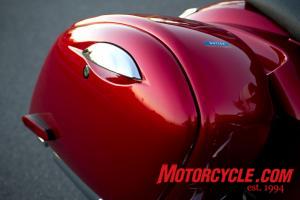
Styling is elemental to cruiser/bagger design, and the Vaquero’s smooth, flowing lines, from the frame-mounted fairing with color matched inner fairing to the sculpted hardbags weaved into the shape of the tail section, the Vaquero’s look says that form is just as important as function for this Kawasaki.
Locking hardbags are a key element of the Vaquero’s style, and they work well. However, styling dictated approximately a 0.5-gallon reduction in storage capacity when compared to bags on the Nomad and Voyager.
All is not perfect, unfortunately, as the faux tank strap doesn’t fully disguise its plastic reality; and in a sacrifice to style the Vaquero’s 9.6-gallons-each side loading saddlebags lost about half a gallon of space compared to the Voyager and Nomad’s top-loading bags. The Vaquero’s bags operate with a reassuringly solid-functioning chrome handle/latch.
It’s prudent that the Vaquero’s bags require a key (same as ignition) to open and close so as to prevent your stuff readily dumping out. But the bags’ fixed mounting method, rather than a tool-less and easily removed Dzus fitting like the Harley and Victory use, makes accessing each of the Vulcan shock’s rebound damping adjuster atop the shock body unnecessarily frustrating. You’ll need patience or smallish hands, or both, to reach behind the saddlebags in order tweak the shocks.
Contrary to this lil’ shock access peccadillo is Kawasaki’s thoughtfulness in placing two helmet hooks under the saddle.
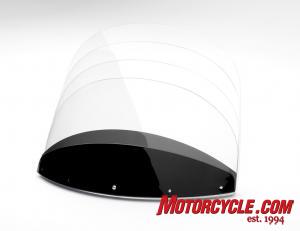
The large fairing and almost-not-there, style-conscious 6.0-inch windscreen sufficiently protected my 5-foot 8-inch frame from the wind without excessive buffeting, but taller riders may have a different, less favorable experience. A simple remedy for unwanted windblast is to choose from one of five optional screens ranging from 6.5 inches to 18.0 inches in height.
No, this isn’t some wacky new ratcheting windscreen for the Vaquero, but is a graphic display of the six different available shield heights, including the standard short screen.
The standard screen and optional 6.5-inch unit are both dark tint; the remaining taller accessory screens are only available in clear.
Speaking of options for the Vaquero, about the only one not on offer is ABS. The Vaquero is otherwise just about as loaded as any bagger comes, with a robust sound system providing AM/FM/WX, and is XM ready – all that’s necessary is the accessory XM module – while the AUX mode on the sound system allows use of an MP3 player via an accessory adapter.
The sound system’s volume/mode and track/station selector switches on the left-side switch gear are joined by a built-in CB function switch that waits patiently for the addition of an optional CB system. Switches for the standard cruise control (also on Voyager and Nomad) are located on the right-hand switch housing. Cruise activates when in 3rd gear or any speeds between 30 and 85 mph.
A rider can increase or decrease cruise speed by as little as 1 mph at a time thanks to the EVT (Electronic Throttle Valve – type of throttle-by-wire) used on the Vaquero as well as on the Nomad and Voyager.
On the subject of adapters and music, the Vaquero’s left-side locking glove compartment is prewired to plug into Kawasaki’s accessory iPod adapter kit that comes with a foam-rubber holder for your iPod. The adapter is pre-molded in the shape of the compartment for a secure fit.
The Vaquero’s comprehensive sound system is ready to accept XM radio and music from your iPod after adding necessary accessory adapters. The red bike’s inner fairing receives a second paint treatment to ensure a smooth, glossy finish.
Thirty-five accessories are available now with many more in the chute; and when it came time to plan for Vaquero accessories, Kawasaki took a calculated approach to making the bike as plug-n-play as possible.
The bike’s wiring harness has many accessory plugs prewired (like the aforementioned iPod connector plug), and the ability to purchase accessories a la carte allows a consumer a modular path to building exactly the Vaquero they want without committing to extras they aren’t necessarily interested in.
Ride ‘im, cowboy!
Prior to the Vaquero’s launch, the Victory Cross Country arguably provided a whole lot of bang for the buck.
The Vic offers the roomiest saddlebags in the class, a comprehensive sound system, second-largest V-Twin in the class, a stout aluminum frame joined by excellent overall ride quality and comfort, all for $17,999.
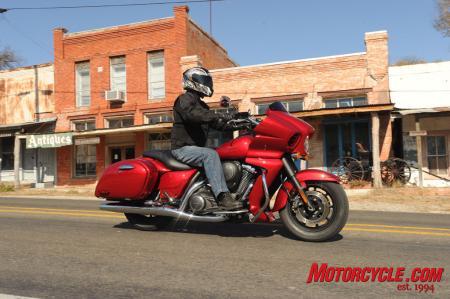
“On a steel horse I ride…” The name Vaquero is Spanish for cowboy. The Vulcan Vaquero’s ergos suited Pete’s 5-foot 8-inch frame and 30-inch inseam perfectly.
Motorcycle Trailer Used
Although the 2011 Kawasaki Vulcan 1700 Vaquero’s 1700cc engine isn’t quite as big as the Victory’s 1731cc lump, when we lasted dyno tested a Vulcan 1700cc in the Vulcan Classic vs. Triumph Thunderbird comparo, the Vulcan managed 86.3 peak ft-lbs. In our 2011 Bagger Shootout the Victory Cross Country churned out just less than 89 ft-lbs.
We’d expect a little better performance from the Vulcan’s liquid-cooled engine, but then again we’re only talking a deficit of a couple ft-lbs.
Furthermore, the Vulcan’s chassis performance and ride comfort are right there with the Victory. And the Vaquero provides a level of rider entertainment comparable to the Cross Country, including multi-menu access for MP3 players. Standard cruise also matches the Victory.
One of the few areas the Kawasaki comes up short to the Cross Country is hardbag volume. But the Vaquero’s impressive standard three-year warranty with optional warranty add-ons extending base coverage an additional one to three years is a rare offering in the moto world. And the warranty remains in tact if you use Kawasaki accessories.
Star’s Stratoliner Deluxe has the most powerful V-Twin in the segment, but beyond the extra power, and an iPod connector in its batwing fairing, it’s hard to justify the Star’s $17,499 price in the face of the competition.
No question the Vaquero is influenced by the venerable Road Glide Custom from Harley. The bike from Milwaukee is a quality machine and it has an excellent dash, but for now H-D doesn’t offer a plug and play setup for the iPod – something I see as a new standard.
This Kawasaki cowboy is looking to stir up trouble with all the other baggers in town.
Triple Your Money!
Then of course there’s the issue of the Harley RG Custom’s smaller 96 c.i. Twin (good for 80.4 ft-lbs the last time we dyno’d), not-so-great rear suspension, the extra $295 required for cruise control and a class-topping base MSRP of $18,999. In fairness, what Harley does boast over most other brands is typically good resale value.
With the recent addition of Victory’s Cross models, the bagger battle has almost overnight become a war in which a manufacturer must offer the most motorcycle for the least cost – not just the best bike at any cost. Victory sets the bar high in this new paradigm.
But now comes the $16,499 Vulcan Vaquero to meet most of Victory’s standard; a good ol’ fashioned duel ensues. Perhaps the new guy in town might even beat Victory at its own game.
Kawasaki Ninja ZX-14R Preview
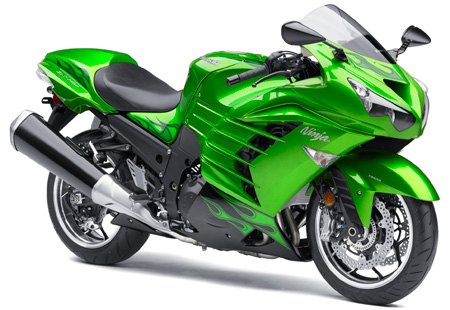
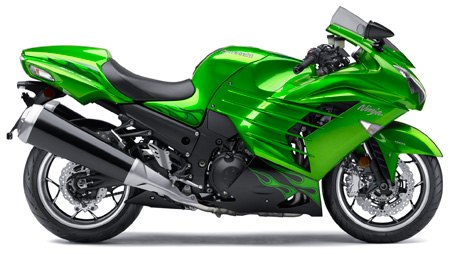
Today Kawasaki finally pulled the wraps off its 2012 ZX-14R.
In 2008 Kawasaki implemented a number of tweaks and updates to the 14 aimed at improving low-end power, but the new model was given a head-to-toe going over for 2012. Although the land rocket of a sportbike retains a familiar look while gaining the R designation, below the surface the biggest of the Ninjas received its most comprehensive revision since its 2006 debut.
Headlining changes are a host of revisions for the big inline-Four powerplant, along with two firsts for the ZX-14: Kawasaki’s traction control system (KTRC) and a slipper clutch.
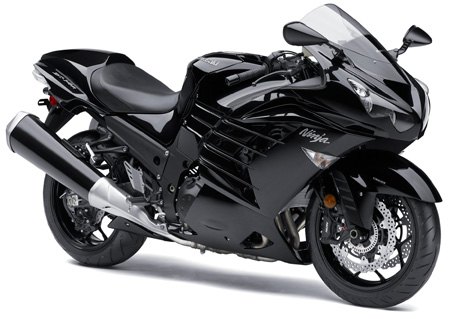
The all-new 2012 ZX-14R. From wheels, to engine, to bodywork, to the frame, the big 14 received a serious goin’ over.
Engine Updates: More CCs to Please the Power Hungry
Leading off engine updates is a 4.0mm increase in stroke, from 61.0 to 65.0mm, while the 85mm bore remains unchanged. The ZX’s previous 1352cc was a class-leading displacement figure, but with the new 85.0mm x 65.0mm bore and stroke the 14 ensures its place as displacement king with 1441cc. Compression is also up, from 12.0:1 to 12.3:1.
Combustion chamber shapes were optimized for 2012, and they’re now surface-milled now rather than cast. Intake ports are reshaped and polished for improved flow, and new, longer intake valves have better durability, according to Kawasaki.
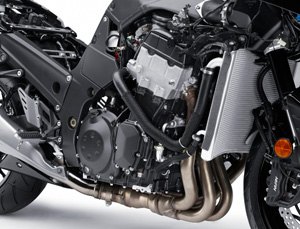
A thoroughly revised ZX-14 engine gets a bump in displacement, now 1441cc, as well as numerous upgrades and updates. Expect even more power than the previous ZX-14.
New camshafts have increased lift and revised profiles, while a stronger cam chain and revised tensioning system have improved reliability. Newly designed forged pistons with thinner crowns are lighter, and like many of the engine components, offer increased durability. The new pistons (paired to stronger connecting rods) are cooled by a new oil-jet cooling system that pumps a continuous stream of lubricant at the underside of each piston. Kawasaki says testing shows the engine runs considerably cooler with this piston cooling system.
Crankshaft main journals are thicker, from 38 to 40mm, and the engine’s dual gear-driven counter balancers have revised balance weights to help mitigate vibes in the longer-stroke engine.
A new air-cleaner element is larger and thicker, with 10% more surface area and 40% more airflow capability, allowing better breathing for the revised fuel injection system. The exhaust system is essentially all-new with reshaped, larger-diameter tapered header pipes, and larger-volume, reshaped mufflers each house a catalyzer.
Manufacturers aren’t always willing to divulge horsepower ratings, and this time is no different, but we can safely speculate crankshaft power above 200 ponies. The previous model claimed 190 hp at the crank with peak torqe at 113.5 ft-lbs at 7500 rpm. The last time Motorcycle.com dyno tested the 14, the big ZX produced 159.5 hp at 9550 rpm and 99 ft-lbs at 7800 rpm.
Here you can see the revised main fairing’s increased venting. An all-new exhaust system is also part of the revamp.
Kawasaki says the myriad changes and updates to its biggest sportbike engine have led to more power at nearly every point in the rev range, claiming stronger acceleration from 4000 rpm onward.
For the ZX-14’s U.S. launch in 2006, and its mid-cycle model revision in 2008, Kawasaki purposely selected drag strip testing as part of the program for the moto media to experience the big Ninja’s power. During each of those events Motorcycle.com editors came away impressed with the strength and durability of the ZX’s clutch, as it endured hard launch after hard launch down the quarter-mile. So while no one questioned the 14’s clutch performance over the years Kawasaki nevertheless improved upon a good thing, and included a race-derived slipper clutch as part of the bike’s overhaul for 2012.
Additionally, to cope with the engine’s newfound power, transmission gears have been heat- and surface-treated for improved durability and smoother shifting action.
Frame and Chassis Updates
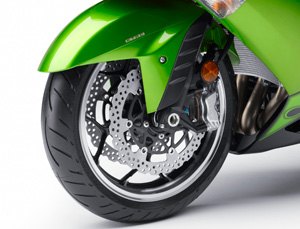
New 10-spoke wheels are a total of 3.3 pounds lighter than last year’s wheels. New brake discs are said to improve feel at the brake lever.
Kawasaki says engineers modified more than half of the previous frame’s aluminum castings and forgings, all of which have different flex and rigidity characteristics than the parts they replace. A somewhat more obvious change is a 10mm longer swingarm, largely accounting for a longer wheelbase, up 58.3mm from 57.5mm. Rake and trail figures of 23.0 degrees and 4.7 inches remain unchanged.
The Ninja’s 43mm inverted fork with 13-way compression damping adjustment and 11-way rebound damping, as well as the fully adjustable shock, have revised internal settings and are said to better resist bottoming. Spinning at each end of this super sled are all-new 10-spoke machined aluminum wheels that Kawasaki says are a total of 3.3 pounds lighter than the previous wheel set. Attached to the new wheels are reshaped petal-type brake discs made from a more rigid material. The new discs along with new brake pad material are said to increase feel at the lever.
Despite the useful weight loss in the wheels, the new ZX-14R’s claimed curb weight is now 584 pounds, up from the previous bike’s nearly 567 pounds. This follows an increase in dry weight in 2008 when the ZX-14 gained 11 pounds (a result of the then new exhaust system) from the 2006 model’s dry weight of 474 pounds.
New Bodywork: Subtle but Tougher Looking
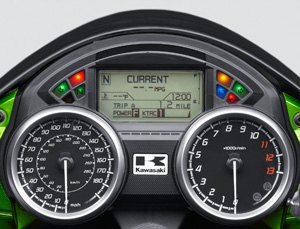
New instrument cluster includes displays for KTRC and power mode selection. Analog dials for the speedo and tach nicely balance the gauge package.
Kawasaki has given the svelte-looking-for-its-size ZX subtle but useful updates to the bodywork.
The frontal area of the fairing has a more aggressive nose design and the quad-headlight glass assembly is now reshaped so as to create the look of two separate lights rather than four on the previous 14. The traditional 4-fin theme along the fairing’s sides has a more pronounced 3D design this year, which Kawi says better vents engine heat away from the rider and passenger. Designers also took pains to conceal as much as possible body panel fasteners and hooks.
Faired-in turn signals remain part of the bodywork, as does a pillion cover – standard on all U.S.-spec models – but a newly shaped seat is claimed to offer better support while making it easier for shorter riders to reach the ground. However, the 31.5-inch seat height remains the same.
KTRC: Power Modes with Traction Control for the New ZX-14R
Perhaps the biggest update to the new 14 other than engine changes is the inclusion of KTRC, Kawasaki’s proprietary switchable engine mapping and traction control system.
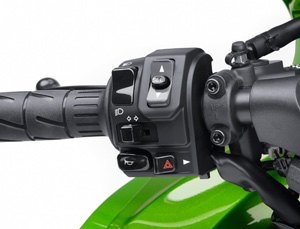
New switchgear contains toggle switch with integrated selector button. This toggle/switch handles many functions, including controlling KTRC.
The system features three different riding modes – full power, medium power and a third mode for low-traction (wet/slippery) conditions. A bar-mounted toggle/push switch on the left switchgear controls KTRC, and the system’s effects can be monitored on a seven-segment bar graph in the cockpit’s LCD info-screen. While Kawasaki didn’t state specifically the parameters KTRC uses to control traction on the ZX-14, it is likely a derivative of the system on the Concours 14.
Despite inclusion of KTRC, ABS is still not part of the repertoire of the ZX’s safety features.
The new ZX-14’s instruments and controls have been reworked as well, with a newly finished gauge cluster and a new multi-function switch on the left handlebar that handles all system functions.
Colors for the 2012 ZX-14R are Metallic Spark Black, Candy Surf Blue or Golden Blazed Green with special graphics (SE). Pricing is currently set at $14,699, an $1100 increase from 2011.
The new ZX-14R continues to push the boundaries of big, fast sportbikes.
Kawasaki KX250F Review
It was easy to love last year’s Kawasaki KX250F. Yes, it had a carburetor, handling was merely average and even the looks and ergonomics were a little dated. What made it such a hit? Power. The 2010 KX250F engine ran so strongly nothing else mattered. The 2010 bike was so good that KX250F sales rose 18% while other brands of 250Fs saw sales drop.
We became acquainted with the 2011 KX250F at the North American press launch at Budds Creek. Engineers were excited to show off their hard work; the new KX250F received over 30 changes from the previous year, including the biggest of them all, fuel injection.
We liked the 2010 model so much we were afraid Kawasaki was “fixing what ain’t broken,” so it was interesting to collect feedback from Greg Jones, the son of three-time AMA MX Champ Gary Jones. We left Budds Creek enthusiastic about the new machine, but were still a little skeptical. Let’s face it; a pro rider on a world-class motocross track, surrounded by factory-trained technicians, isn’t an accurate representation of how a bike will work in the real world.
Before we dig into the 2011 KX250F a techno refresher is in order. The Kehin battery-less fuel injection system is just like the one used on the KX450F, only with different calibration. The ECU is tunable with software from Kawasaki, allowing riders to adjust the powerband to their riding style and track conditions. A gear position sensor, an air pressure sensor, a water temp sensor and an air pressure sensor are used to optimize the air/fuel ratio. The system also incorporates a vehicle down sensor, designed to shut the engine off if you crash.
On paper the new engine makes slightly more mid to top-end power than last year. In the name of increased reliability the 2011 KX250F engine also has new cams, valve springs, a new piston, a new cylinder, a new crankshaft, revised gear ratios and a new gearshift mechanism. The air intake volume and the exhaust header length were massaged to improve low-rpm response, and the new muffler was designed to meet AMA noise standards.
It seems weird to only have one fork spring, but the new Showa Separate Function Fork (SFF) system has adjustable preload, compression and rebound damping and weighs 1.5 pounds less than the old fork. It also has less stiction and is less expensive to service or modify. The tripleclamp offset has been reduced to 22.5 mm in the quest for increased front wheel traction.
The shock is Kashima treated to improve smoothness, and has revised damping settings for 2011 to better match the new fork. Leaving no stone unturned, Kawasaki engineers changed the engine mounts from stiff aluminum to more flexible steel as a way to gain lighter handling and better cornering! The saddle has a new cover with increased side grip. Kawasaki says the bike weighs 232.7 pounds, but it feels lighter than that when you’re moving it around in the garage.
We knew from our time at Budds Creek how well the KX250F worked on a Pro-level MX track, so we spent most of our ‘real-world’ test doing other stuff. We ripped around on around first and second gear singletrack like an off-road racer, rode fast Euro-style grass tracks like an ISDE racer and even searched out Endurocross-type obstacles to hop over.
Back in 2010, despite having a carburetor, we praised how easily the KX250F started. Well don’t worry; with fuel injection the KX-F starts every bit as well as last year. When cold simply pull the choke/idle speed knob, roll the bike over a couple times to prime the EFI system and then give it a full kick. Hot? One full, solid kick and she lights up almost every time. At typical sound test rpm the new muffler is pleasingly quiet. Go beyond that, with a good twist of throttle, and the KX250F is just as loud and raspy sounding as ever. Over the course of a week our test bike grew louder as muffler packing, our hearing and our neighbor’s patience, deteriorated. Thankfully the aftermarket is full of quiet performance pipes these days.
EFI lets the engine pull smoothly off the bottom then revs quickly and barks into a stellar midrange hit. It’s almost two-stroke-like. For an experienced rider that snap is useful on the motocross track, and with a practiced clutch finger, it works off the track too. At higher RPM the power tapers until you hit the rev limiter. No, the KX250F is not the easiest to ride 250F ever but it is very likely the fastest. The fuel-injected engine never once flamed out, stalled, gurgled or did anything except run great.
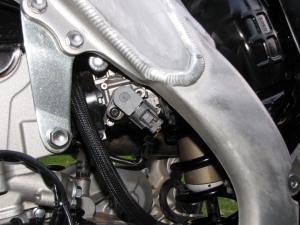
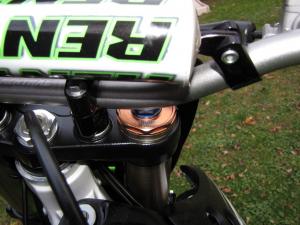
The close-ratio five-speed transmission has a good overall spread of gears and final drive gear ratio for most tracks. Trail riders or novices might want to gear it down a tooth or two, but since the Kawasaki engine is so smooth off idle it’s not much of an issue. The newly revised transmission had average action and had a nice light clutch feel, but about halfway through our test it became more difficult to shift gears under load for some reason. We never missed a shift but it took more toe effort than it did at first. The clutch itself remained flawless for the entire test period.
The new SFF front end worked well, if a bit soft for Pro riders, on the track. With stock damping adjustments but five clicks less preload the fork worked well on the trail also. Our test riders ranged from 150 to 200+ pounds, so we can conclude the SFF forks are not only versatile but also suit a wide range of riders. The SFF system also makes valving or spring rate changes relatively inexpensive compared to conventional motocross forks.
The shock also worked nicely, generating almost no whining from our test pilots. Typically motocross, it was a bit too firmly damped on high-speed compression for our slower testers in the woods, but overall it did a good job of absorbing both trail hack and moto leaps.
Ergonomically the KX250F feels a little thick for a 250F. It has a comfortable seat and a fairly wide fuel tank. Compared to some motocross bikes that are a little too hard edged to be truly comfortable, the KX-F feels almost like a trail bike. But this is a race bike, pure and simple. Unlike Honda’s CRF250R, which can sometimes trick you into thinking you’re aboard a play bike, the KX250F always feels like a racer. It is stable enough at speed, but despite the chassis changes the KX-F still doesn’t own the corners like an RM-Z. The brakes were excellent, and the entire KX250F package encourages you to ride faster.
The bike comes with a plastic skid plate that is a nice addition for moto or for normal trail use, but is not strong enough for budding Endurocross racers. When we took our test bike trail riding we did nothing more than install Enduro Engineering handguards, but if we owned a KX250F we’d be installing more serious off-road armor, an o-ring chain and a quieter muffler.
Things our testers didn’t like were the obnoxious exhaust note, the noisy (but effective in shaking mud off the chain) serrated chain roller and the way the bike aged right before our eyes. It’s obvious we really like the KX250F. From our preview at Budd’s Creek we knew we liked it as a motocross bike, but now we also like it as a woods racer. So far it’s at the top of our list for 250F of the year. The KX250F is a great motocross bike, and when ridden aggressively will happily become a very effective new-school enduro racer.
2012 Kawasaki Versys Review
When Suzuki alluded to the Kawasaki Versys as a competitive benchmark for the born-again V-Strom 650, we took note. Not having ridden the Versys since its 2010 makeover, we ordered one up in advance of a comparison test.
Since last reviewing the Versys, its cost has grown $300 from an MSRP of $7,600 in 2010 to $7,900 for 2012. What three more Bens buys you is a new color (a striking Pearl Solar Yellow/Ebony combo) and a bunch of inflation. The 2010 Versys' $500 price bump boasted a host of upgrades including:
* A new fairing, stacked dual headlight, new front fender and mirrors, and an LED tail light
* A larger windscreen with three-position adjustability
* Revised passenger grab rails, new seat cover material, and revised passenger seating position
* Rubber bushings at the rear engine mounts and hollow rubber-covered footpegs
* Revisions to the muffler, clutch cover, sprocket and alternator covers, radiator shrouds, swingarm pivot covers and rear fender
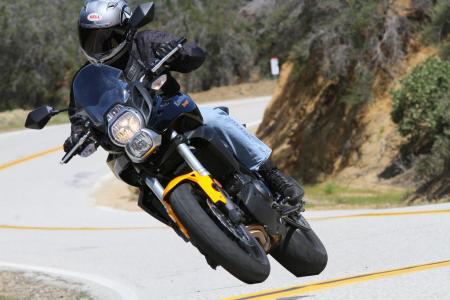
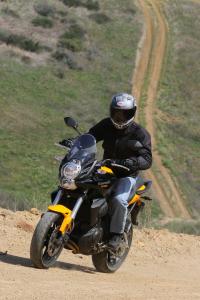
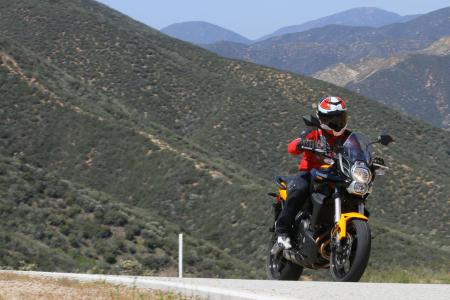
The Versys won't be pigeonholed, but it's more sportbike than off-roader.
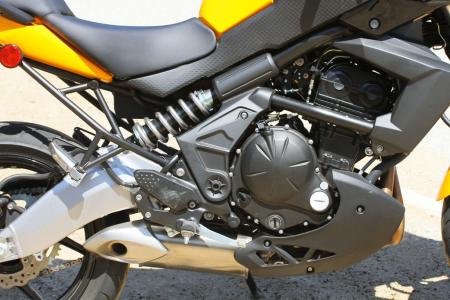
The Versys, with its longish (5.9 in. front and 5.7 in. rear) suspension travel and tall 33.3-in. seat height, conveys a certain degree of off-road capability, but its 17-inch cast aluminum wheels and Dunlop Sportmax tires speak to its true nature. Sure, a person can modify the Versys to be more capable of off-road work, but more suitable bikes exist. Our forthcoming shootout will examine the relative merits of each manufacturer's approach to achieving a useful street/dirt balance.
In the street/dirt balance equation, the Versys leans heavily toward the street and is a strong performer in the twisties. But its under-engine exhaust and 17-inch tires aren't conducive to aggressive off-road riding.
As an urban-assault cycle, the Versys excels. Its snappy, 649cc parallel-Twin engine jettisons away from stoplights and makes short work of navigating heavy city traffic. The large passenger grab handle doubles as an effective appendage for securing items when in-transit, while the Versys' mirrors provide an unobstructed view of dangers approaching from behind.
Beyond city limits the Versys is a great weapon for attacking gnarled switchbacks and embarrassing sportbike pilots tiptoeing across chunked asphalt. Or, attach Kawasaki's available hardbags and head out for a tour of the contiguous 48. The Versys' neutral seating position provides a balanced combination of comfort and control, and its three-way adjustable windscreen deflects more or less wind depending on the situation.
The result of trying to keep a fairly low seat height is a short distance from footpegs to seat that cramps taller riders and is exacerbated by a concave section at the rear of the seat where tall riders sit. Our shorter testers weren't bothered, but tall riders are faced with increasing discomfort as the miles accumulate - those above six feet might want to look at aftermarket alternatives.
Long-travel suspension and 17-inch wheels send a mixed message, but the Versys will handily navigate the common fire road. More aggressive off-roading will require more enduroesque tires.
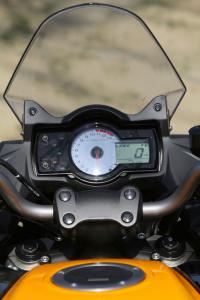
No frills here, but the gauge cluster is clean and legible. Dual tripmeters are a nice touch, as is the adjustable windscreen that shelters riders of various sizes.
Kawasaki endowed the Versys with rebound and preload damping adjustability to both the 41mm inverted front fork and lay-down rear shock. The instrument cluster, while spartan, includes a fuel gauge, clock and dual tripmeters. Adjustable clutch and front brake levers ably fit a variety of hands.
After 200 miles, tall riders will grow to heavily dislike this saddle. Roderick describes it as a thinly disguised torture device, but our shorter testers judged it as satisfactory.
At approximately 490 lbs with its 5.0-gallon tank full, the Versys is kind of hefty for a mid-displacement Twin producing 56.5 hp at 8250 rpm, but its linear powerband is a willing accomplice in most any situation short of long, open roads or a racetrack. Fuel mileage in our hands was in the low-to-mid 40-mpg margin, so the Versys has an admirable range of more than 200 miles. Its 6-speed transmission was less impressive, exhibiting a clunky response to our toes.
Consensus in our 2010 review of the Versys was "if faced with a budget for only one mid-size street bike, a lot of riders - old, young or in between - might want to take a closer look at the Versys."
What we'll soon discover is how the Versys stacks up against two equivalent, yet more dirt-worthy adversaries. At $8,300 - including ABS - the Suzuki V-Strom is marginally more expensive than the Versys, but is the 645cc, V-Twin-powered Strom a better all-around bike? Same goes for the $7,850 BMW G650GS, which also incorporates ABS but is powered by a relatively meek 652cc Single.
Subscribe to:
Posts (Atom)